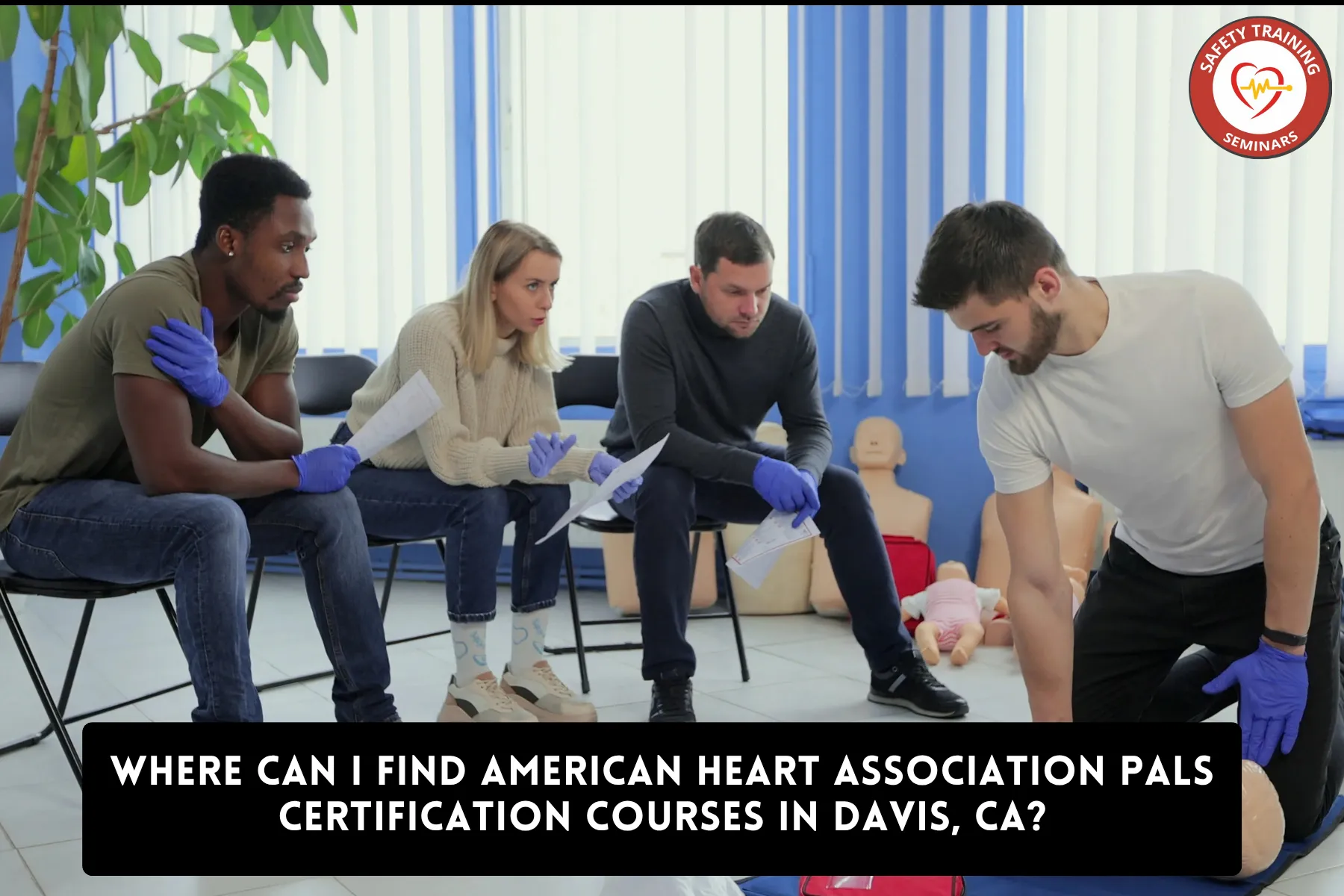
In Davis, you can take an American Heart Association PALS course at Safety Training Seminars, an AHA Training Center in downtown Davis. The Pediatric Advanced Life Support (PALS) course there uses a blended format: you complete the online coursework at your own pace, then finish a short hands-on skills test at the downtown location. When you pass, Safety Training Seminars issues your AHA PALS Provider eCard the same day, and it is valid for two years.
Davis has an unusual mix of healthcare learners. Some are students working toward clinical careers. Others are working nurses, physicians, and paramedics who commute to hospitals across Yolo and Sacramento counties. This guide is written for both groups. It covers who actually needs PALS, how the local course works, and how to avoid paying for the wrong certification.
PALS in a College Town: Who Actually Needs It?
A lot of people search for a PALS class in Davis when what they really need is BLS. Here’s the difference.
Basic Life Support (BLS) is the foundational CPR credential for healthcare providers. Most nursing, pre-health, EMT, and allied health programs require it before clinical placements, and many entry-level healthcare jobs ask for it.
Pediatric Advanced Life Support (PALS) is an advanced course for clinicians who manage seriously ill or injured infants and children. It goes well beyond CPR. It teaches you to recognize respiratory failure and shock early, interpret pediatric rhythms, calculate weight-based medication doses, and lead or support a pediatric resuscitation team.
PALS is usually required for:
- Emergency department nurses and physicians who treat children
- Pediatric, PICU, and pediatric cardiac unit staff
- Paramedics and other advanced prehospital providers
- Respiratory therapists in pediatric or critical care settings
- Residents and advanced practice clinicians in pediatrics, emergency medicine, or family medicine
If you’re an undergraduate preparing for a clinical program or a scribe or EMT job, check your program or employer requirements first. You may only need BLS for now.
How Pediatric Emergencies Move Through the Davis Region
Davis sits near one of Northern California’s main pediatric referral centers, and that shapes why PALS matters to local clinicians.
UC Davis Children’s Hospital is in Sacramento, not in Davis itself. It describes itself as having the Central Valley’s only pediatric emergency department and Level I pediatric trauma center. It is a 129-bed hospital with neonatal, pediatric, and pediatric cardiac intensive care units, and its pediatric emergency department serves a referral region of more than 33 counties.
Closer to home, community hospitals such as Sutter Davis Hospital treat children too. Sutter Health notes that all of its hospitals care for children, while specific facilities such as Sutter Medical Center, Sacramento, are equipped for more specialized pediatric needs.
In practice, a sick child in Yolo County may first be assessed in a community emergency department or by a paramedic crew, stabilized, and then transferred to a pediatric center. Those first minutes of assessment and stabilization are exactly what PALS trains clinicians to handle. It matters just as much for the community ED nurse who sees children only occasionally as for the PICU nurse who sees them every shift.
The Downtown Davis Training Center
Safety Training Seminars’ Davis center is at 508 Second Street, Suite 208D, Davis, CA 95616, in downtown Davis. The business places it near E Street and F Street and the Davis Amtrak station, a few minutes from the UC Davis campus. It also notes parking and bus routes nearby. Posted hours are 8 a.m. to 10 p.m., seven days a week, and the center can be reached at (530) 601-2065.
The Davis location offers AHA BLS, ACLS, and PALS, plus NRP and CPR and first aid courses. If you need more than one credential, for example BLS and PALS before a new pediatric job, the Safety Training Seminars Davis CPR and BLS classes homepage lists every course offered at this location.
From Sign-Up to eCard: How the Davis PALS Course Works
The PALS course in Davis follows a two-part blended model.
Step 1: Complete the online coursework
The online portion covers the core PALS content: pediatric assessment, respiratory and shock management, rhythm recognition, cardiac arrest algorithms, medications, and team dynamics. Safety Training Seminars estimates it takes two to three hours. You can work through it on your own schedule, which helps if you are juggling classes, clinical rotations, or 12-hour shifts.
Step 2: Pass the hands-on skills test in Davis
After the online part, you visit the downtown center for skills testing, listed at about 30 minutes. You demonstrate infant and child resuscitation skills, such as high-quality compressions and effective ventilation, to AHA standards.
Step 3: Receive your eCard
Once you pass both parts, your AHA PALS Provider eCard is issued the same day. You can download it and send it straight to your employer or program coordinator.
For current details on the initial and renewal pathways, see the Davis PALS certification course page.
Student or Working Clinician: Which Course Fits Your Role?
| Your situation | Course you most likely need |
| Undergraduate entering clinical volunteering, scribing, or EMT work | BLS |
| Nursing or medical student starting clinical rotations | BLS (PALS only if your program or rotation requires it) |
| ED, pediatric, or PICU nurse | BLS and PALS |
| Paramedic | BLS, ACLS, and often PALS |
| Labor and delivery or NICU staff | BLS and NRP (PALS depends on the unit) |
| Adult ICU or telemetry nurse | BLS and ACLS |
These are general patterns, not rules. Requirements vary by employer, unit, and program, so confirm with your manager, unit educator, or clinical coordinator before you register.
What to Check Before You Register
A few minutes of planning can save you a second trip:
- Confirm the requirement. Ask whether your employer or program specifically wants AHA PALS, and whether it accepts blended (online plus skills) courses.
- Keep BLS current. PALS skills testing assumes solid infant and child CPR, and most employers also require a separate, active BLS card.
- Finish the online module first. Your skills appointment can’t be completed until the online portion is done.
- Watch academic calendars. Downtown Davis gets busier around the start of quarters. If you’re a student facing a rotation deadline, book your skills session early.
- Verify the price. At the time of writing, the Davis site listed PALS at $290 with a low-price guarantee and was advertising a promotional discount. Confirm the current price when you enroll.
Frequently Asked Questions
Do UC Davis students need PALS?
Most don’t, at least not early on. Pre-health and early clinical students usually need BLS. PALS typically becomes relevant during pediatric or emergency rotations, residency, or a job in a pediatric or emergency setting. Check your program’s requirements.
Is the PALS course in Davis an official AHA course?
Yes. Safety Training Seminars is an AHA Training Center, and successful students receive the official AHA PALS Provider eCard.
How long is a PALS card good for?
Two years. Most clinicians renew a month or two before the expiration date so their credentials never lapse.
Can I get to the training center without a car?
Possibly. The center is in downtown Davis near the Amtrak station, and the business notes bus routes nearby. Check current transit schedules for your route before your appointment.
What’s the difference between PALS and NRP?
PALS covers infants and children in emergency, inpatient, and prehospital settings. NRP, from the American Academy of Pediatrics, covers resuscitating newborns at delivery. Some clinicians need both, depending on their unit.
Booking Your PALS Certification Course in Davis
For Davis-area clinicians and advanced students, Safety Training Seminars’ downtown center on Second Street offers a practical path to AHA PALS: online coursework on your own schedule, a short local skills test, and a same-day eCard. Davis sits close to a major pediatric referral center, and local community emergency departments and EMS crews regularly stabilize children before transfer, so PALS skills apply well beyond the PICU. Confirm what your employer or program requires, make sure your BLS is current, and then book a skills time that fits around your classes or shifts.