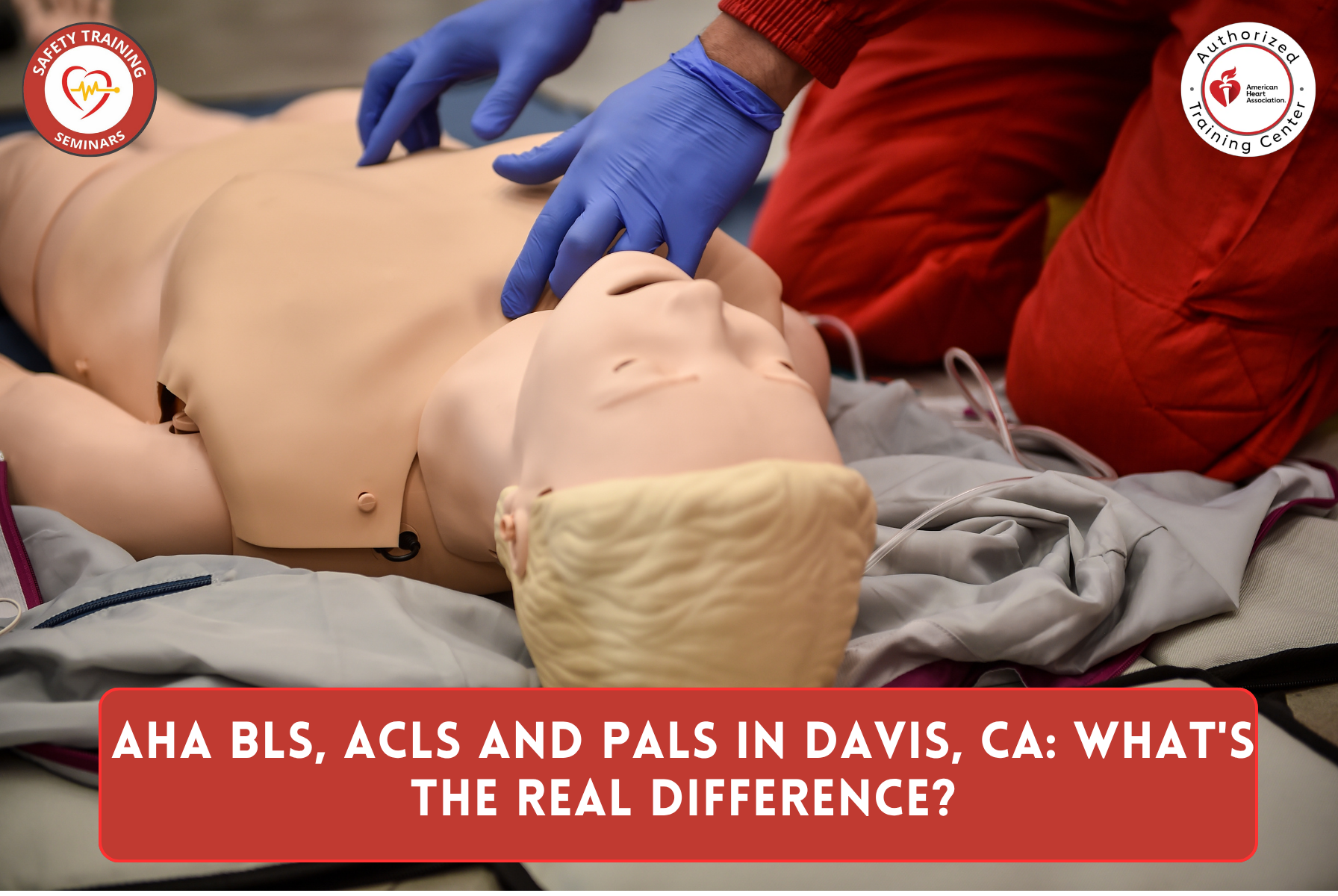
Understanding the distinct boundaries between American Heart Association (AHA) training credentials is a critical step for healthcare professionals and clinical students working in Davis, CA. While all three certifications focus on life-saving cardiovascular intervention, they target entirely different clinical scopes, patient populations, and intervention complexities. Registering for the wrong class can stall a clinical rotation, delay hiring onboarding, or result in unfulfilled licensing prerequisites.
Key Takeaway: Basic Life Support (BLS) provides foundational high-quality CPR and airway management for all healthcare roles. Advanced Cardiovascular Life Support (ACLS) focuses on adult cardiac algorithms, pharmacology, and ECG interpretation, while Pediatric Advanced Life Support (PALS) addresses specialized resuscitation protocols for infants and children.
Defining the Core Clinical Scope of Each AHA Course
The American Heart Association structures its healthcare curricula sequentially, building from baseline physical resuscitation up to complex pharmacological and electrical interventions.
Basic Life Support (BLS)
BLS serves as the foundational requirement for virtually all healthcare disciplines. The curriculum emphasizes early recognition of sudden cardiac arrest, high-quality chest compressions, team-based resuscitation, bag-valve-mask (BVM) ventilation, and automated external defibrillator (AED) integration across adult, child, and infant patients.
Advanced Cardiovascular Life Support (ACLS)
ACLS expands on foundational BLS skills by addressing urgent management of adult cardiac arrest, peri-arrest conditions, acute coronary syndromes, and stroke. Participants learn manual defibrillation, continuous ECG rhythm interpretation, airway management tools, and intravenous/intraosseous resuscitation pharmacology.
Pediatric Advanced Life Support (PALS)
PALS establishes systematic assessment and intervention frameworks for pediatric emergencies. Because pediatric cardiac arrest is most frequently secondary to respiratory failure or shock, PALS emphasizes early airway stabilization, vascular access, fluid resuscitation, and age-specific pharmacological dosing.
Direct Comparison of AHA Healthcare Certifications
Choosing the appropriate training track requires evaluating target patient demographics, required clinical skills, and typical workplace roles:
| Course Feature | Basic Life Support (BLS) | Advanced Cardiovascular Life Support (ACLS) | Pediatric Advanced Life Support (PALS) |
| Primary Focus | Baseline CPR, AED, & BVM ventilation | Adult cardiac arrest & peri-arrest care | Infant & child resuscitation algorithms |
| Patient Demographics | Adult, pediatric, & infant | Adult patients only | Pediatric & neonatal populations |
| Prerequisites | None (entry-level clinical entry) | Active BLS certification & ECG reading | Active BLS certification & pediatric baseline |
| Key Interventions | Chest compressions & barrier ventilation | Advanced airways, IV/IO meds, cardioversion | Pediatric dosing, IO placement, shock care |
| Target Audience | Nurses, EMTs, dental staff, students | ER/ICU nurses, physicians, paramedics | Pediatric nurses, PICU staff, ER personnel |
Determining Which Certification Your Employer or School Requires
Workplace mandates stem directly from patient exposure risks and clinical responsibility levels. Reviewing clinical expectations helps determine your exact requirement:
- General Healthcare Personnel & Students: A foundational BLS CPR certification course is universally mandated for nursing students, dental practitioners, medical assistants, physical therapists, and allied health staff.
- Adult Emergency & Critical Care Clinicians: Nurses and physicians working in intensive care units, emergency departments, cardiac catheterization labs, or post-anesthesia care units require both BLS and ACLS credentials.
- Pediatric Specialists & Emergency Personnel: Healthcare providers in pediatric units, emergency rooms, urgent care clinics, and pediatric transport teams generally maintain both BLS and PALS certifications, with many emergency personnel holding all three.
When uncertain, always verify current job descriptions or school onboarding portals before enrolling to confirm whether single or dual credentials are expected.
Understanding Course Structure: Initial vs. Renewal Options
AHA certifications remain valid for two years through the end of the issuance month. Selecting the proper course format depends on your current certification status and experience level.
First-time participants or clinicians whose cards have expired beyond the official grace period must complete a full initial training session. These courses provide comprehensive instruction, guided skill practice, and structured testing scenarios.
Clinicians maintaining an active, unexpired card can enroll in a streamlined renewal course. These sessions focus on updated guidelines, algorithm reviews, and hands-on skills verification within a shorter timeframe. Bringing your current card to class is standard verification practice.
Why In-Person Skills Testing Matters for Healthcare Compliance
Online education platforms often promise instant digital certificates without requiring hands-on practice. However, clinical employers, state licensing boards, and hospital credentialing committees consistently reject 100% online certificates that lack physical skill evaluation.
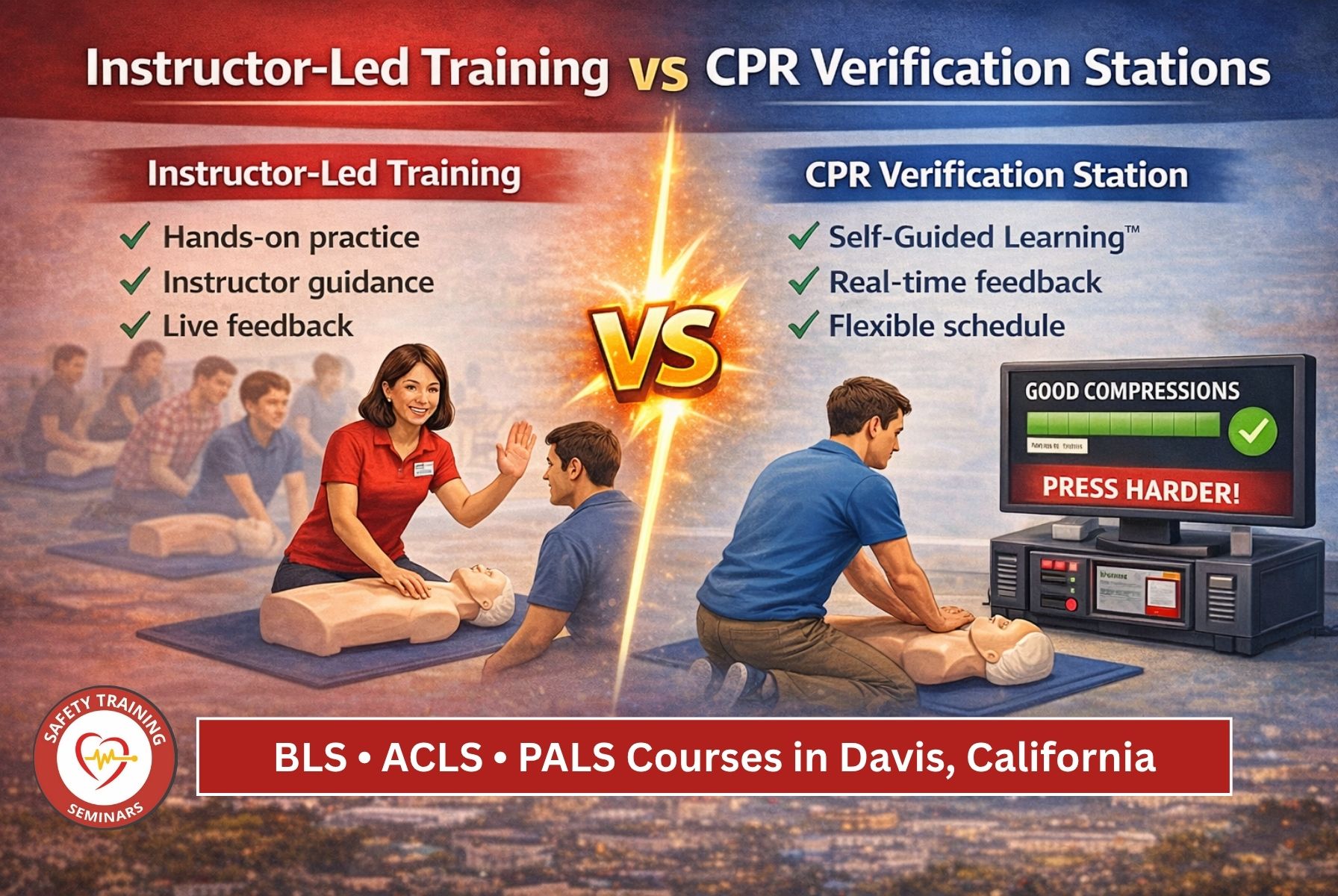
Effective CPR and advanced life support depend heavily on physical coordination, appropriate compression depth (2 to 2.4 inches for adults), proper bag-valve-mask chest rise, and effective team communication. Authoritative AHA training models rely on physical skill testing—either led by an instructor or conducted via feedback-equipped manikins—to ensure clinicians possess verified motor skills.
Selecting an officially recognized training format guarantees your card will be accepted by regional health systems and academic institutions without delay.
Local Healthcare and Academic Training Demands in Yolo County
Davis operates as a prominent regional hub for healthcare education, veterinary medicine, and clinical research. The presence of major academic medical networks, local clinics, and community care centers creates a steady demand for verified AHA credentials.
Nursing students, medical residents, and allied health staff entering clinical rotations throughout Yolo County must maintain active BLS cards before stepping into patient care environments. Furthermore, emergency medical responders and hospital staff in nearby communities frequently travel to centralized training locations to fulfill annual or biennial compliance updates.
Whether you work in local outpatient clinics, regional medical centers, or mobile emergency services, maintaining current credentials ensures seamless credentialing across regional healthcare employer networks.
Completing AHA Credentials with Safety Training Seminars
For healthcare providers and clinical students seeking compliant certification in Yolo County, accessing reliable local training schedules is essential for maintaining career momentum. Safety Training Seminars offers official American Heart Association courses designed to fit demanding clinical schedules.
Classes are conducted locally at the Safety Training Seminars Davis CPR Training Center Address: 508 Second Street, Suite 208D, Davis, CA 95616. This central location provides convenient access for local residents, UC Davis students, and healthcare workers throughout the region.
Clinicians and workplace teams commuting from adjacent areas can easily review localized class availability, including options for West Sacramento BLS and CPR classes, upcoming Winters certification schedules, and Woodland healthcare training options.
Frequently Asked Questions
Can I take ACLS or PALS without an active BLS certification?
No. High-quality CPR is the foundation of both ACLS and PALS algorithms. Most official training centers require proof of a current BLS certification prior to attending an advanced resuscitation course, though some facilities allow clinicians to complete BLS and ACLS concurrently.
How long do AHA BLS, ACLS, and PALS certifications remain valid?
All American Heart Association healthcare certifications remain valid for two years through the last day of the month in which the course was successfully passed. Employers or school programs may require recertification sooner according to internal policy.
Are blended learning options accepted for BLS certification in Davis?
Yes. HeartCode BLS blended learning—which combines online cognitive learning modules with an in-person, hands-on skills evaluation on feedback manikins—yields the exact same official AHA BLS provider card as a traditional classroom course and is fully accepted by employers.
What should I bring to my AHA class in Davis?
Students attending a classroom or skills session should bring proof of any required online course completion certificates (for blended learning), their current AHA certification card (if attending a renewal class), and comfortable clothing suitable for floor-based physical skills practice.
Moving Forward with Your Healthcare Certification
Selecting between BLS, ACLS, and PALS comes down to your current license type, patient population, and facility requirements. Starting with foundational BLS ensures you master essential resuscitation mechanics before advancing to complex pharmacology and rhythm management.
To maintain compliance and avoid interruptions in your clinical practice or academic coursework, verify your exact employer prerequisites early. Reviewing local course offerings in Davis allows you to select the precise training track and class time needed to fulfill your professional requirements efficiently.