Davis is a city built around bikes, research labs, and a university campus that never fully slows down, and each of those worlds has its own reason for asking about BLS CPR certification. A nursing student needs it for a clinical rotation. A lab technician needs it after a supervisor flags it during onboarding. A longtime cyclist just wants to know what to do if someone goes down on the Greenbelt path. The requirement looks the same on paper, but the reasons people show up for it in Davis differ.
If you’re trying to figure out whether you need a full BLS provider course or something simpler, the short answer is this: BLS is built for people who respond to medical emergencies in a clinical or occupational setting, while general CPR and First Aid classes serve everyone else. What matters next is confirming which one your program, job, or department actually requires before you enroll in the wrong one.
Key takeaway: BLS CPR certification is the standard credential for healthcare students, lab personnel with safety obligations, and clinical staff, and it typically includes an in-person skills check in addition to any online coursework. Most American Heart Association BLS cards are valid for two years, though your department or employer may set an earlier renewal expectation.
Why Davis Has Such a Mixed Group of BLS Students
Few college towns have quite this combination of audiences walking into a CPR class. UC Davis draws nursing, veterinary, and pre-med students who need BLS for clinical placements. The city’s research and biotech presence means lab staff working with chemical or biological hazards often carry an occupational safety requirement that includes emergency response training. And then there’s the everyday cyclist or parent who wants the skill for personal reasons, not paperwork.
Understanding which category you fall into changes what you should ask before enrolling. A nursing student needs a card that satisfies a specific clinical program’s documentation standards. A lab employee usually needs whatever their EHS (Environmental Health and Safety) office specifies. A cyclist or parent has more flexibility in course format since no institution is checking the paperwork.
BLS vs. General CPR: The Distinction That Actually Matters
BLS provider courses are built around team-based resuscitation: two-rescuer CPR technique, coordinated AED use, and the kind of structured response expected in a hospital, lab, or clinical setting. General CPR and First Aid courses cover single-rescuer response for the public and tend to spend more time on choking, wound care, and everyday emergencies.
If your UC Davis program handbook or lab safety documentation says “BLS,” a general CPR card usually won’t satisfy that requirement, even though both classes teach chest compressions and AED use. The safest move is to check the exact wording of your requirement rather than assume the courses are interchangeable.
What a BLS Class Actually Involves
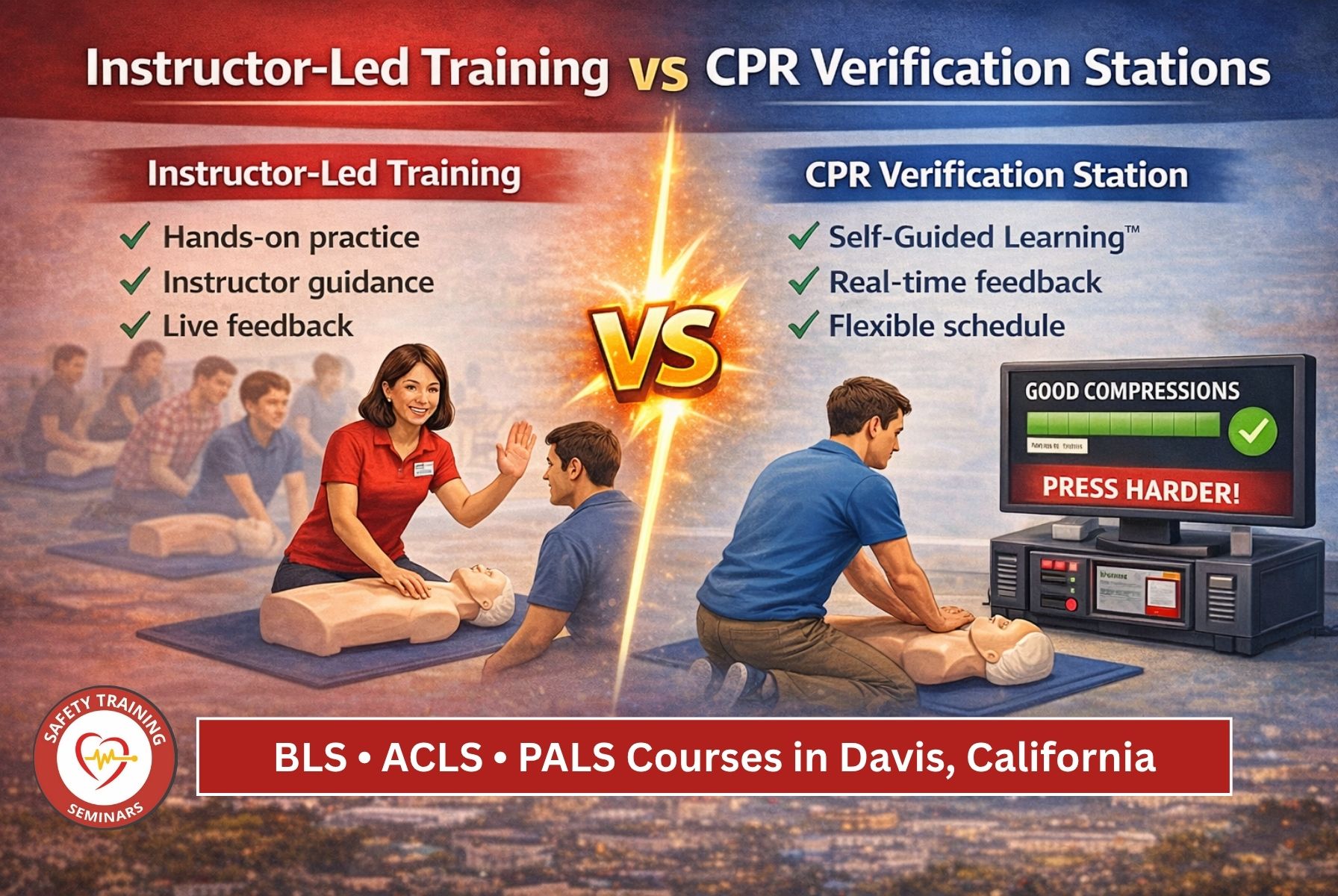
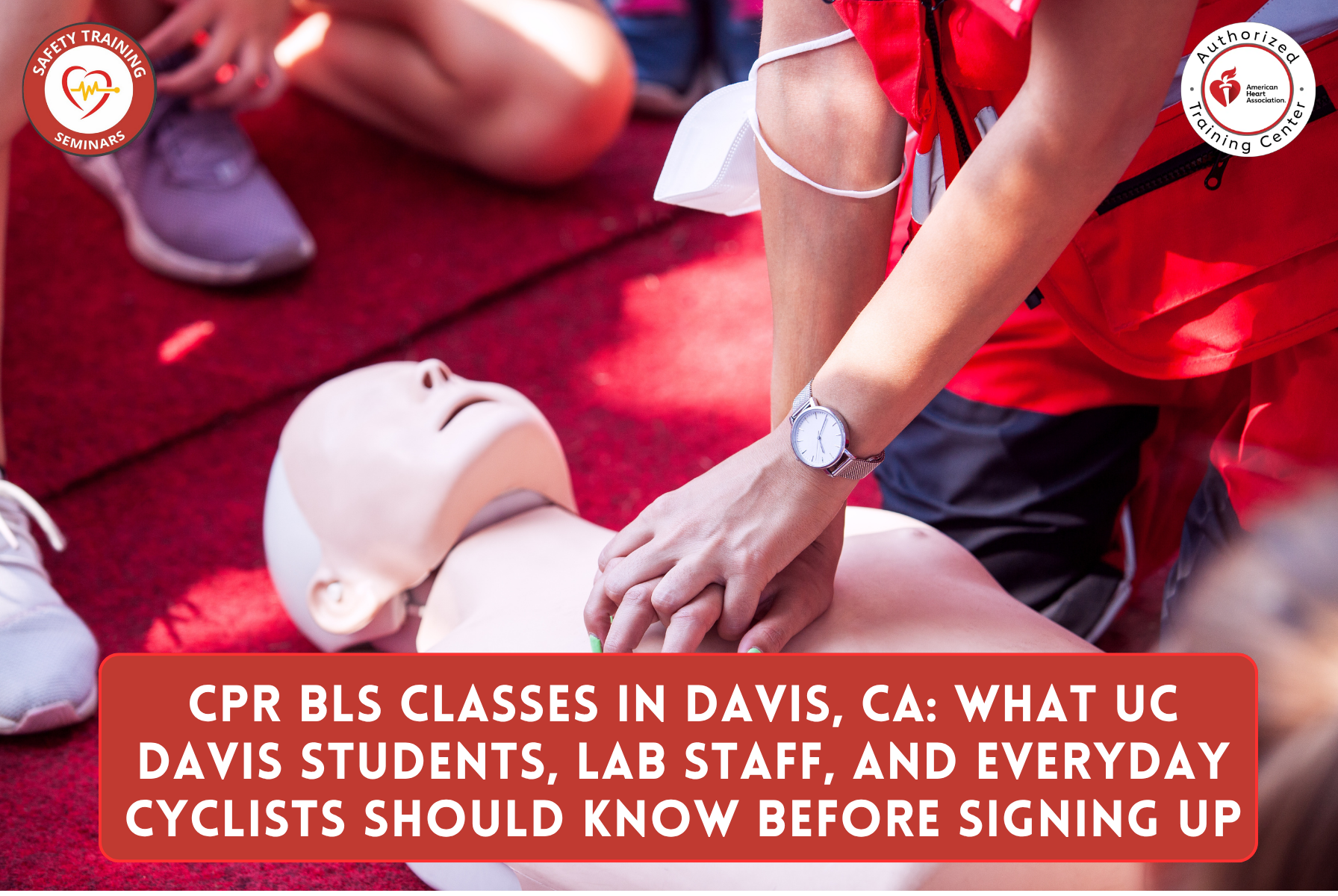
Most current BLS courses use a blended structure. Students complete an online cognitive portion covering resuscitation science and current guidelines, then attend an in-person skills session where an instructor or a supervised skills-verification system checks compression depth, rate, hand placement, and AED technique on a manikin.
This hands-on portion is where most students notice the gap between reading about compressions and actually performing them at the correct depth and rate under evaluation. If you’re a first-time student, that’s a normal part of the process, and instructors generally allow practice time before formal assessment.
Do UC Davis Clinical Programs Accept Online-Only BLS Certification?
This question comes up often enough that it deserves a direct answer: it depends on the specific program. Many clinical placements, hospital systems, and nursing programs require a hands-on skills verification component and will not accept a certificate earned entirely online with no in-person check. Before choosing a fully online option, confirm directly with your program coordinator, clinical instructor, or department office whether skills verification is required, since enrolling in the wrong format can mean redoing the course closer to a placement deadline.
How Long Does BLS Certification Stay Valid?
American Heart Association BLS provider cards are generally valid for two years from the completion date. Clinical programs and hospital-affiliated departments sometimes require renewal ahead of that expiration as part of internal compliance schedules, so it’s worth checking your specific program’s timeline rather than relying on the standard two-year window alone.
Choosing a BLS Course That Actually Fits a Davis Schedule
Between lab hours, lecture blocks, and clinical rotations, schedule flexibility matters more in Davis than in less academically dense cities. A few practical questions to ask before enrolling:
- Does the course offer both online and in-person skills-check components, or in-person only?
- Is there a physical Davis location for skills verification, or would you need to travel to Sacramento?
- Does the card clearly list the completion date and expiration, which most programs require?
- Can the skills check fit around lab hours or clinical shifts rather than one fixed class time?
Safety Training Seminars in Davis
Safety Training Seminars operates a training center at 508 Second Street, Suite 208D, Davis, CA 95616, in downtown Davis, offering BLS, CPR, ACLS, PALS, and First Aid courses for healthcare students, lab personnel, and community members. The location sits within walking distance of the UC Davis campus area, which has made it a workable option for students who need to complete a skills check between classes rather than losing a full day to travel.
For lab staff working under an EHS-mandated safety requirement, a downtown training center means the skills-verification portion doesn’t require a trip out of town. If your schedule makes a Davis session difficult, Safety Training Seminars also maintains dedicated course pages for BLS and CPR classes in Woodland and CPR certification training in West Sacramento, useful if a different class time works better for a lab shift or clinical rotation.
Considerations for Nearby Communities
Yolo County residents often split their week between Davis and neighboring towns, which affects which class location makes sense. Someone commuting from Winters for a lab position in Davis, for example, might prefer a session closer to home rather than adding extra driving time after a shift. Safety Training Seminars maintains a course page for BLS and First Aid classes serving Winters for exactly that kind of scheduling situation, and the main Davis course listing covers the full range of BLS, ACLS, and PALS options available in the downtown location.
Frequently Asked Questions
Do UC Davis nursing or pre-clinical students need BLS specifically, or is general CPR enough? Most clinical placement programs require BLS specifically because it includes team-based resuscitation skills expected in hospital settings. Confirm the exact requirement with your program coordinator before enrolling, since a general CPR card typically won’t satisfy a clinical placement requirement.
Does a Davis lab job actually require CPR certification? It depends on the lab’s specific safety plan. Some biotech and research labs in Davis include CPR or BLS training as part of their Environmental Health and Safety requirements, particularly for roles working with hazardous materials. Check with your EHS office or supervisor for the exact requirement.
Can I complete BLS certification without missing a full day of lab work or class? Many current BLS courses split into an online portion you complete on your own time and a shorter in-person skills check, which tends to fit more easily around lab hours and lecture schedules than a full-day, all in-person format.
How long is my BLS card valid after finishing the course in Davis? American Heart Association BLS cards are generally valid for two years from your completion date, though your specific clinical program or employer may set an earlier renewal expectation.
Is there a CPR class option near the UC Davis campus itself? Safety Training Seminars’ Davis training center at 508 Second Street, Suite 208D is located in downtown Davis, within reach of the campus area, and offers BLS, CPR, ACLS, and PALS courses for students and staff.
What should I bring to my BLS skills-check session? Bring a government-issued ID and, if you’re renewing, your current certification card. Wear clothing that allows you to move freely, since the skills check involves kneeling and positioning for compressions.
Deciding on Your Next Step
The clearest path forward starts with confirming exactly which certification your program, lab, or employer requires, since BLS and general CPR aren’t interchangeable for clinical or occupational purposes. From there, the course format that fits your lab hours or class schedule usually matters more than which provider you choose.
Safety Training Seminars’ downtown Davis location at 508 Second Street, Suite 208D offers BLS, CPR, ACLS, and PALS courses for UC Davis students, lab staff, and community members throughout Yolo County. If a Davis class time doesn’t align with your schedule, the linked course pages for nearby Yolo County communities are worth checking before you commit to a specific date.